It Begins with a Nightmare
My goal with Narrative Eversion is to look at complex works of media and try to understand the motivations behind the creative choices which make them tick. These themes truly come to life when studying video games because of the complex interplay between creator intent and play choice which is inherent to the genre, but aspects of film studies, literary analysis, and systems design are all essential to this theory. I can't think of any better place to introduce my analysis technique to you than with Alan Wake, for reasons which I hope will become clear as we begin.
Alan Wake is a survival horror action-adventure video game from Remedy Entertainment, released in 2010. Like many games of its era, it has some highly experimental mechanics for both gameplay and story presentation. Join me as we begin the story of Alan Wake and try to burn past the dark shell of janky mechanics and questionable design decisions to understand exactly why, in a game where we're given a flashlight and a gun, sometimes a typewriter is the most powerful weapon.
We're going to begin with the opening of Alan Wake, literally with the attract screen that sits there when your computer is idling after the game has launched. I know this seems like we're paying attention to teensy tiny details that sometimes are made by an intern or other low level employee at a studio.
Here, we begin in dramatic and stylish fashion with a bold title screen saying not just the name of the game, but showing us, through the letters of our main character's last name, the environment in which we will journey, dodge, and fight for our very survival. And our main character, our avatar through this story, takes his place right here in the title.
This is not unusual in video games. Throughout the '90s, for example, many games had exciting ways of integrating their title into new and strangely shaped box art. I’m specifically remembering the wedge shaped Tomb Raider box that got prominent placement at GameStop and the many years during which I chuckled to see the Diablo Battle Chest still shelved at Walmart.
This screen has something to tell us. It tells us that Alan is mostly alone. It tells us that he is trying to wake not just from sleep, but from something more. Note the haze around the letters. Note how Alan is armed with a pistol but holds up his flashlight.
We're going to step into the game now, and as the story begins to unfold before us, we're going to consider: what is it that makes Alan Wake so special, even so exciting as a starting place for Remedy's connected universe? Because for those of you who are not aware, Remedy Entertainment has a vast interconnected alternative history associated with their video games. This really came to light with Control becoming more and more popular over the last few years, and then Alan Wake 2 breaking out and gaining some major critical acclaim. So starting here with the original game, at least in its remastered form, it's telling that we begin with a Stephen King quote.
Stephen King once wrote: "Nightmares exist outside of logic. There's little fun to be had in explanations. They are antithetical to the poetry of fear."
Leaving aside that "antithetical" is a delightful word to say, "the poetry of fear" is a phrase to linger upon.
What is it that we feel when we're afraid? What makes us feel terror, anxiety, concern? According to this quote and the explanation which briefly follows from our main character, the key to instilling fear is pushing one’s audience to ask questions, but not provide clear answers.
As long as we are asking questions, as long as we are being pulled forward by uncertainty, we are held in a position of perpetual uncertainty. It’s from that point, that pivot, that trecharous path through the dark forest, that the audience or player is kept engaged.
Why are we being attacked? Why is the darkness surrounding us? Why is Barry Wheeler so important to this story and kind of saves it in some ways?
We're not going to answer every question that comes to mind in the course of our exploration together, in part because to answer every question would be to utterly remove some of the joys of the game, and partially because there are not solid answers for every question. Because as Remedy tells us, in the voice of our protagonist, quoting one of the greatest horror writers in American history: answers are antithetical to the poetry of fear.
That doesn't mean that we're going to avoid answers though. It doesn't mean we're going to hide from answers. We will be looking for answers as we dissect how Alan Wake navigates this challenging story and how we, as players, are compelled onward by the narrative and the mechanics of the game. We're going to be looking for the whys and seeing if we can take things apart to find the answers, or find the deeper questions.
Alan Wake begins with a dream sequence. This is a choice that many authors of horror media tend to follow, because dreams are common. Dreams are something that most people share. Dreams, despite their inherent illogic, are a fixed point of the uncanny where we all can find common ground.
It's one thing to tell people, "Here's a lighthouse surrounded by a stormy sea, shining its light out into the darkness." It's entirely another thing to hint about dreams that we all share, to remind people of how wild and dark our own dreams can become and while we are saying these things, show a lighthouse. Show a destination. Show a contrast between wakefulness and sleep, or death.
As he describes the typical nightmare pattern that this dream begins with, Alan explains that he was late, desperately rushing to his destination. Again, something that many of us can relate to when we think about starting a dream in the middle. Many dreams do start with a sense of happiness or fear, or anxiety, or peace. Connecting with the writer, connecting with the players, connecting with the viewers.
Note how Alan describes the anxiety of his dream, using words to connect the player to the emotion of the scene. Visually, we also have tricks that are used in film and television. Specifically, as Alan's car races through the fog along winding roads on steep hillsides and cliffs, the camera frequently switches angles to heighten the sense of tension in each shot. Some of this has to do with directorial style and the technology available at the time, but many of these angles are specifically chosen to evoke the uncanny, to evoke mystery.
Take, for example, the town sign we see on the right side of the screen as Alan rushes into Night Springs. Is this the name of the town that Alice Wake took her husband to? No. This is the first of the connections to metafictional realities that will become incredibly important in Alan Wake, Control, and come to dominate the narrative by the time we reach Alan Wake 2.
This metafictional reality of Night Springs we will talk about more, but it's sufficient for now to note that this is not the name of the town that Alan and Alice are going to. And to see, as you study the single frame of the opening movie, how jaws close around the name. The jaws of shadow, the fangs. This is just the shadows of pine branches thrashing in the wind, but the image of a mouth closing around the words "Night Springs" as Alan rushes to drive towards a lighthouse that he does not know why he needs to get to is one of the small rhymes in this poetry of fear.
Another important image which appears in the opening moments of Alan Wake: Alan's car races through a pool of light before entering a dark tunnel.
We'll speak of tunnels more soon. We'll speak of passageways and thresholds. Keep your eye out for these. Not just as you're playing Alan Wake or as we're going through this story together, but as you watch television, as you read books or play games. How often are those liminal spaces important? How often do we pass through a doorway, a gateway, a tunnel? How often do we go across a bridge before we change our perspective, before we change the sense of what is important to ourselves?
In this story, Alan passes through the tunnel, and immediately upon leaving the darkness there is a hitchhiker in front of him. And he strikes the hitchhiker with his car and immediately knows that he has killed the man. This is a dream. Of course Alan knows immediately, because in dream logic, we can know that which has not yet been told to us.
I encourage you to think about these bold, blunt, obvious opening statements. The combinations of showing on screen and telling in dialogue. Consider whether, to you, these feel like repetition for the sake of clarification, whether they feel like imitations of hackneyed writing, or if it genuinely shows a little bit of uncertainty, perhaps a lack of confidence in whether players will follow the visual narrative if the storyteller does not imitate it in the audio narrative.
We're coming to the end of the opening video and as darkness steals away the light from Alan's car. And then the body of the hitchhiker disappears, leaving Alan standing framed by the tunnel beside his broken car, waiting to see what will happen next.
In this nightmare, we take control.
In just that moment, as Alan is feeling uncertainty and we are perhaps as players feeling uncertainty about what this game is going to be, control is handed to us. This is a moment of ludonarrative coherence. We'll break it down a little bit:
"Ludo" just means to play.
"Narrative" means a story.
And "coherence" means everything fitting together, or resonating, or sticking together.
And that is what we find in these opening moments of Alan Wake, as we're given control of a player character and told to press forward to the lighthouse. Alan’s uncertainty and fear are transferred to us.
There are some truly wonderful moments of awkward uncertainty even here as we enter the playable portion of the story. We hury from the broken-down car to a pool of light, to the next pool of light, the next safe haven. From here, we have a few small choices. We could continue on down the road towards the bridge, which is just barely noticeable in the shadows as being broken. If we were to continue on to that bridge, we would see that there is no way a car could pass, and in fact we can't even get across on foot. There is a collectible there if you choose to look, but the game pushes our attention towards the lighthouse.
We have been given an objective marker so we know that we want to keep that yellow dot at the top of the circle which is our radar, a common feature in games of this era. Whether that radar shows other useful details is something we'll see as the story progresses. Up there we also can see at the top left of our screen our health bar. Even though we have not yet been told this is our health bar, we can assume as much given that it is red and broken into segments.
Sticking with our visual analysis for a moment: even as the yellow lines of the road hint that we could continue onmto the bridge, the bright lights which we have been following tell us that we need to head towards the lighthouse. The lighthouse itself shines to us as it rotates a beam of light continually across the landscape while the next streetlight beckons to us nearby.
In addition to using light to guide us onward and shadow to indicate where we should not go unless we're seeking additional collectibles, we see an example of including real-world signage to indicate to us where we should go to find the lighthouse. We see a hiking trail sign with a large arrow pointing towards a boardwalk that we can follow to the Rain Cove Point lighthouse.
We're being pulled towards the lighthouse by light. We're being pulled onto the boardwalk by light. And we have in-universe signage which is very reminiscent of any state park signs you may have seen if you have gone out to a park. All of this works together to pull the player forward.
And then the rug is pulled out from under our feet a little bit. Because just as we pass a notice board that in the waking world would be covered in hiking maps, notices of what poisonous snakes or large bears or rabid raccoons may be common in this area, perhaps some regulations about campfires or where you're allowed to set up tents, the game rips control away from us. The camera whips about, forcing our perspective to look back at the car and then breaking away from that perspective in a new cut, taking us back to the exact place where Alan was standing not two minutes ago. Now, instead of us standing there controlling Alan, we see the hitchhiker's perspective. And now he's armed.
For the slightest instant we wonder if we might get control of the hitchhiker, thanks of this shift in perspective. But rather than giving us control of the hitchhiker to dish out damage to our own character, the game teleports the hitchhiker to the same threshhold we just passed and we are handed back control of Alan.
The hitchhiker menaces us by knocking down the notice billboard, axing whole sections of railing off of the boardwalk, even chopping down the light pole for the safe haven we had just passed, destroying not only our comfort as a player but our trust in where we will find safety.
This is one of those moments in game design where, across different eras, the methods by which designers share story with the player have radically altered. In some eras and in some styles of game, we would be allowed to continue running without those camera breaks. In other genres such as JRPGs, this whole experience thus far might still have been a cutscene that would probably go on for another 20 minutes.
What we're seeing here in 2010 is different eras of game design and different techniques of interacting with the player colliding, as Remedy experiments with bringing in more and more of the cinematic stylings to tell their stories. At some point we'll be going into Uncharted, and I think you'll be as fascinated as I am to see the differences in storytelling and the differences in cinematic moments versus player-controlled moments between Alan Wake and Drake's Fortune, which came out three years before, a both games experiment with cinemating storytelling in wildly different ways to similarly mixed results.
And as we continue on in Narrative Eversion through both of these series as well as other games and other forms of media, I hope you will continue to pay attention to when authors trust the audience versus when, whether from a lack of confidence, a piece of team-based decision-making, or what the creators genuinely think is the best choice for telling their story in the time and place in which that story was being created.
In this case, as we gain control of Alan again and run away from the hitchhiker, we are forced past a moment of no return: The stairs are destroyed as we fall down them. This is another moment of narrative and gameplay partially colliding and partially working in harmony. We've just had control ripped away from us and then given back to us. We've had the camera change perspective multiple times. And now, as we recover from a fall, we have a third mode of interaction.
Other than being in character or watching a cutscene, now we have the choice to press a button on the game controller to further interact with the scene. This is one of those moments where, if I were to ever interview the creators at Remedy, I would be so curious to know... less why and more how they chose these different moments and these different modes of presenting the story.
In this moment of dream, in this first four minutes of gameplay, we can see the creators at Remedy grappling not only with how to tell a narrative in which a somewhat introverted individual, but how to externalize the fears that he faces. Do we externalize them by filling the scene with soldiers carrying weapons? No. We externalize it by taking a character from one of his stories and putting in that character's mouth all of the fears that Alan has: that he's a lousy writer, that he uses cheap thrills, that the few bits of seemingly original thought that he might have are just "pretentious shit." And that's all that he's good for.
The hitchhiker demanded that we look at him. That Alan look at him. That Alan look at what he has created, and suffer.
And we did.
This forced interactivity in order to see the mockery of the writer stands in contrast to the more cinematic moment of being shown that the hitchhiker is a threat, and then shown that the hitchhiker can teleport closer to us, and then being allowed to run away as some story-shaping but less personal insults are hurled at us.
We're going to pause for just a moment at the next notice board, even though we feel the impetus to hurry on in the game. This is absolutely a moment that one might call ludonarrative dissonance, because there are things worth studying here even as we are afraid to stop lest the murdered man catch up with us.
Starting right to left as we look across the illuminated notice board, we see a yellow concert poster. It's hard to tell what's going on as it's an old poster, a borderline mimeograph in how rough the copying is, but we can tell people are playing music and there's bright lights and energy. Skipping over the QR code because we'll talk about the alternate reality game and expanded elements of Alan Wake in a later episode, we get a more clear view of that missing person poster which we have already passed a couple of times... and it's clearly Alan himself. This is not automatically too strange, because this is a dream. Of course Alan would be dreaming of himself, and maybe even externalizing himself from the perspective of a dreaming person into that of a person who is missing.
But what about this final element, the largest poster on the board?
It's a diving suit, an old-fashioned suit of the sort that you might imagine Jacques Cousteau using. Large bronze headpiece with circular viewing portals, sealed in place with large nuts that just make it look mechanical. Make it look menacing even. We are already being menaced by the hitchhiker, so even as we pause to study this and to wonder why we have now twice seen this set of posters and three times seen that Alan himself is missing, we feel the mounting pressure like sinking tino the depths of an ocean. We are compelled as players to push on.
Push on into elements which introduce us to more of the physical interactions, to the need to press X occasionally to jump over a mild obstacle, and more importantly, to the basics of combat in one of Alan Wake's arenas.
Alan Wake stands above many games of its time in that it does use fairly naturalistic combat arenas. If you know what to look for, they're very obvious, but they fit the landscape of real life better than the pneumatic security barriers of your average shooter. You usually jump over or step down into a place that is going to be impossible for you to escape from until you finish the fight, because you're not given a button prompt to climb back out or the path back is removed. And as is so common in video games, we complete a task three times or defeat a wave of enemies in order to make it out of the arena.
So why do I compliment Alan Wake's arenas as opposed to many of the contemporary games which also had dodging and shooting and combat arenas? In my opinion, Alan Wake stands above because the setting provides many natural locations for combat arenas, such as the dodge training zone in the opening dream. Settings where it's not unreasonable that we could be in an enclosed space with fencing preventing us from falling off the edge and down the cliffs to the sea. The state park being in such a state of disrepair, with so many fences guarding cliffs also does make sense given the setting.
Even the element of having gates closing the exits to the arena makes some degree of in-world sense, although whether those gates being locked by an oozing darkness that hovers around them and prevents you from accessing them makes sense... That depends on how you feel about spending all afternoon with your family at a state park,
As Alan presses forward, the player having learned how to dodge our enemies, it's important to consider the order in which we received our instructions: We do not learn how to fight first. We learn how to run at a rather pathetic rate. And we learn how to dodge. And then, once we know how to run and dodge and we know that going to light keeps us safe, then we are almost prepared for the next step.
Once again control is ripped away from the player, though this time a little bit less dramatically. It's just a slight camera pivot, as we see our nemesis the hitchhiker reappear, ready to strike when he's done monologuing.
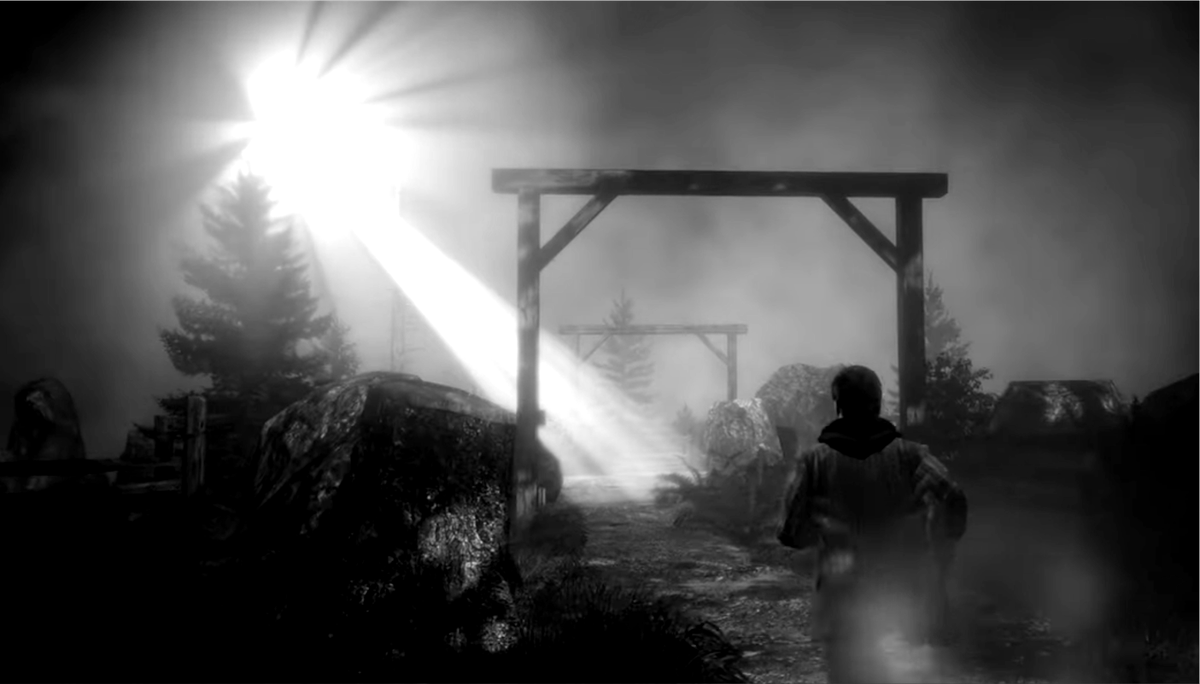
Then the Dark Presence comes and changes everything with a chase sequence. We have just crossed a bridge. We have passed through a little wooden gateway. And now the world is changing again, because rather than going from one source of light to the next to find safety, we are compelled to rush onwards as each of the lamps we approach shatters, flickers, fades away leaving us to hurry onwards. Leaving us to wonder if the rushing noises from behind and the thrashing of the foliage all around us is going to kill us.
Well, I can tell you from a game design perspective: it will. There are many places in Alan Wake that if you do not stay ahead of the black cloud of Dark Presence, it will kill you. Or it will start spawning so many enemies that you will die if you don't immediately run back towards the intended path.
From a ludonarrative perspective, considering that essential challenge of how to keep the player pressing forward and following the plot instead of just boundary-breaking and having fun jumping up and down and seeing if they can surf the wave of the Dark Presence over into the water or something, the howling lethality of the Dark Presence does force players to move.
But move on to what?
We rush forward until we come again to a gateway, to a bridge. From an in-world perspective, this continues to make sense. We have followed yet another footpath. We are reaching a suspension bridge. Everything still looks very much like you might see in a state park.
Except that gateways have been important. A gate led us out of the combat arena. A tunnel brought us into this nightmare. Footbridges have led us both closer to the light and over chasms filled with the Dark Presence. And now we're about to pass through two gateways and over a bridge which spans a void of darkness. A rushing, churning river of wind that just barely hides the sharp rocks below.
And as we rush across the bridge, someone is waiting for us. Someone's shouting to us, someone pulling us forward. This is Clay Steward. We know this is Clay Steward because he introduces himself the moment that we reach him as our path backwards is destroyed by the darkness.
From a narrative perspective, how often in a story, how often in a nightmare, can we not return from whence we came? In our own lives to. This is why we have this trope in video games, movies, and storytelling in general. Time flows forward. None of us can go back in time. None of us can change any mistakes we've made. All of us are constantly rushing forward.
Narratives often give us the opportunity to look back. We can turn pages in a book of our own accord, in either diretion. Many a film's tension depends on the manipulation of narrative expectations via flashbacks. Some games even give us the opportunity to rewind time.
In these opening minutes of Alan Wake, the developers are making a clear statement that as Alan presses forward in this story, pressing forward as a player means eliminating options behind you. It means that the Dark Presence rushing up behind Alan, pouring out of these canyons or perhaps out of his own heart, is forcing both Alan as a character and us as players into inescapable and unchangeable situations.
Even this brief little moment here, where Clay Steward urges us onward, then tells us to go into the cabin, and then bravely gives his life in defense of Alan. In a dream, this is strange. It is inescapable. Just as Alan cannot compel himself to wake up, Clay Steward knows who Alan is and cannot seem to tell Alan why they are connected.
Now, from a narrative perspective, this bothers me. Clay Steward is a named character, and I really wish that he came up later in the game. But I'll just outright spoil it now: Clay Steward will not come up again. Is this a flaw in the game? Maybe. As a part of the narrative, it certainly feels odd to have a named character appear and then never be mentioned again. But as we dig deeper into the Remedy Connected Universe, we will see that for every perhaps flaw in individual stories, we can identify master strokes of narrative design in later elements of the story. We'll see how Clay Steward is connected soon.
As Clay pushes us into the cabin and then fights the Dark Presence for us, physically confronting the hitchhiker, we see how ineffectual bullets are and how brutally effective the axe is. We may not be able to harm the hitchhiker, but he can certainly smash up the surroundings and kill other people. So he can probably kill us too.
This adds to the suspense and leads to a moment of rather awkward horror, as Alan and the player are trapped in this cabin, absolutely unable to escape. No matter how we run around, no matter how long we go left and right and back in circles, this is a timed event. We have to wait until the story is ready to continue.
A book may compel us forward page after page after page, the author using cliffhangers at the end of chapters to urge us to read the intermediate chapter so that we can then get on to the resolution of the cliffhanger in the preceding chapter.
A film may linger for an uncomfortable amount of time on an obscure detail of the scene, evoking emotion through timing and audio and visual focus.
How do you do that in a video game?
In this case, the creators chose to make us sit with Alan's discomfort. To trap us in this space only for a few seconds. But it is enough, especially when there's not many clues to look at, at least at first glance.
But clues there are: There are far too many televisions in this small cabin and each of them bears an eye, a wild eye flicking back and forth as a voice chants "Die!"
I will also draw your attention to a poster.
A poster on the far door of the cabin. A poster for a film called Tom the Poet. At first glance, this seems like some random set decoration, until we consider that that poster bears the image of a deep-sea diver in a metal and glass helmet. A deep sea diver oddly reminiscent of that poster we passed out in the darkness.
Studying this movie poster poster in detail, we note that it speaks of, "A terrifying, strange dive into the dark depths of an artist's mind." This film by Thomas Zane is titled "Tom the Poet." It's when we look at the names on the poster that the layers of surreality begin to assemble. The names listed: Thomas Zane, Barbara Jagger, Cynthia Weaver, Emil Hartman, and Alan Wake. Everyone, it seems, is involved in this production. All of them appear to be connected to this individual wearing a dive suit.
In our final moments here in the cabin, as we await either the Dark Presence breaking in or finding some means of escape allow me to might draw your attention to the production company of this film: Not a Lake Productions.
There's a lot to this, and we're not going to break down every component of it now. But it is a pinprick of light in an ocean of dark clues. This poster front-loads us with all of the important names of the story, if you notice it. And that is a big "if," because after all, we are running around a locked cabin, allowing the player to experience the sort of fear that films and books can only hint at. There's also a hint of the sort of boredom you may have when trapped in a room waiting for... anything.
The door smashes open and then light tears through the very poster we were studying. Light pours into the cabin, dissolving the wall. Light that comes not from the lighthouse we have been approaching this whole time, but from another, stranger source.
We follow a voice, follow the guidance of the light.
We make it to one of the safe havens: One of those lamps that occasionally flickers as we reach it, so we must be cautious.
Our suspicions about those red lines being a health bar around our minimap? They are confirmed as the safe haven heals us.
The voice pulls us onward, metaphorically as well as physically, forcing Alan to contemplate something that doesn't seem especially useful at first glance: a poem.
I'll let you draw your own conclusions about why we would contemplate a poem here, at this moment in the rhythm of the opening sequence. Here, as we stand between a broken past and a dangerous future.
The poem the light insists we must remember goes like this:
For he did not know that beyond the lake he called home lies a deeper, darker ocean green, where waves are both wilder and more serene. To its ports I've been, to its ports I've been.
Do you understand?
This is not just a question for Alan as the character, posed by the mysterious voice in the light. It is a question for us as players as well. It is unlikely that we understand everything that is going on so far, but in the dream logic, everything is beginning to make some sense. The darkness destroys and the light repairs. The darkness is a source of danger, but it can be molified or opposed. It can be put to rest. It can be set aside for a time, unless it fully takes you. Once you are Taken, the Dark Presence can use you to attack others.
Others who may only appear for an instant.
Now it's finally time for the combat tutoria. After learning how to run, how to heal, how to dodge, how to jump, we finally learn how to fight... with a flashlight.
Remember, from the attract screen logo, how Alan holds his revolver but points with his light?
Even as the voice instructs us on how to burn away the shields of our enemies and then kill them with a revolver, the light is essential. It is not until we can see the humanity of our Taken enemies that we can actually destroy them. There's pain there, and some fun game mechamics. It's one of the elements that makes Alan Wake fairly unique as a survival horror or action game: This concept of having a shield which metaphorically represents the darkness taking over the world, metaphorically represents the Dark Presence invading Alan's mind and invading this small American town. Meanwhile, the shield mechanically requires us to track two separate resources in amunition and batteries.
It forces us to think beyond just that literal shell of protection and wonder: why do we fight?
Why do these monsters attack us?
And what is it about the light that brings mingled relief, fear, and destruction?
These are the sort of questions that we don't often ask in action-soaked center of the plot of a game, let alone here in tutorial level.
As we learn how to engage with multiple enemies at once: hinting at us when we should dodge, when we should retreat, when we should use the flashlight to make our enemies cower away from the revealing light versus when we should use our weapon to shoot at them, versus when we should press onward to try and make it to the next safe haven or the next box of ammunition. The simple addition of a light-dependant shield and a way to fight back have already vastly increased the complexity of gameplay mechanics.
There are more elements of tutorial over the next few minutes. We are given a flare gun and have the opportunity to experience just how fun it can be to fight in Alan Wake when you have the correct weapons. The flare gun is just unmitigated joy to use, though amminition is sparse. The arc of each shot burns through the scene, illuminating with dynamic lighting all of the beautiful architecture and natural environments. It's not just about visuals though, because the light of a flare gun burns away the Takens' shields and the burst disolves the enemies into golden light. It's really satisfying.
But it leaves us wondering: why?
What is it about the Dark Presence that makes it take people, makes it use those people as its weapons, as its voice?
Why do they repeat these kind of inane statements about their own lives or about Alan as a writer?
Is this because the Dark Presence is something external? Is it because it is some malevolent force which is entering into Alan's mind?
Or is the presence of all of these shadows of Alan's own writing, all of these reminders of his failures, are these perhaps indicating that the darkness comes from or feeds upon Alan's own psyche? Is his own own cruelty and vanity the enemy here?
The game doesn't allow us to linger over these questions for long. It is, after all, an <interactive movie / third person action / survival horror game>. We have a lovely moment of racing across a bridge as the Dark Presence roils behind us, threatening to overwhelm Alan with its shadows and throwing literal cars to smash the bridge. It's a great dynamic moment that really instills that sense of overwhelming destructiveness. I've been a fan of scenes like this in games for a while, with certain points in Tomb Raider and Uncharted being special standouts. We rush forward until Alan finally is able to hide in the lighthouse. Finally closes a door on this shadow.
This is, however, not the first time that Alan has closed the door on this particular shadow.
And it will not be the last.
Even as Alan finds refuge in the lighthouse. Even as he breathes slowly, knowing with the certainty of dream that he has reached his destination and may now be as safe as one can be in a nightmare.
Even in that moment of releaf, alan steps into the spiral of the lighthouse steps and rather than finding a source of safety, light, inspiration, the light remains far above his head. It remains up there in the turning. And down below, at the base of the dark spiral staircase, Alan is trapped.
Something knows he is here. Something that gets the last word in his dream. A voice. A woman's voice, perhaps.
This is Barbara Jagger.
Why do we hear her? Why is she given this brief, faceless moment of celebrating Alan's arrival in the darkness before he wakes to the voice of his wife?
We'll dig more into that next time.
This has been the first installment of Narrative Eversion with Andrew Linke. Make sure that you let me know your thoughts on Alan Wake over on my YouTube page, here on my website, or over at my Patreon.
I would love to know how you feel about Alan Wake's dream and whether Remedy effectively captured the sense of being in a nightmare. Were there moments where the gameplay, camera angles, and story came into conflict or showed exceptional cohesion for you?
Until next time, I'm Andrew Linke, and I look forward to continuing along Alan Wake's journey into the Dark Place in our next episode.